
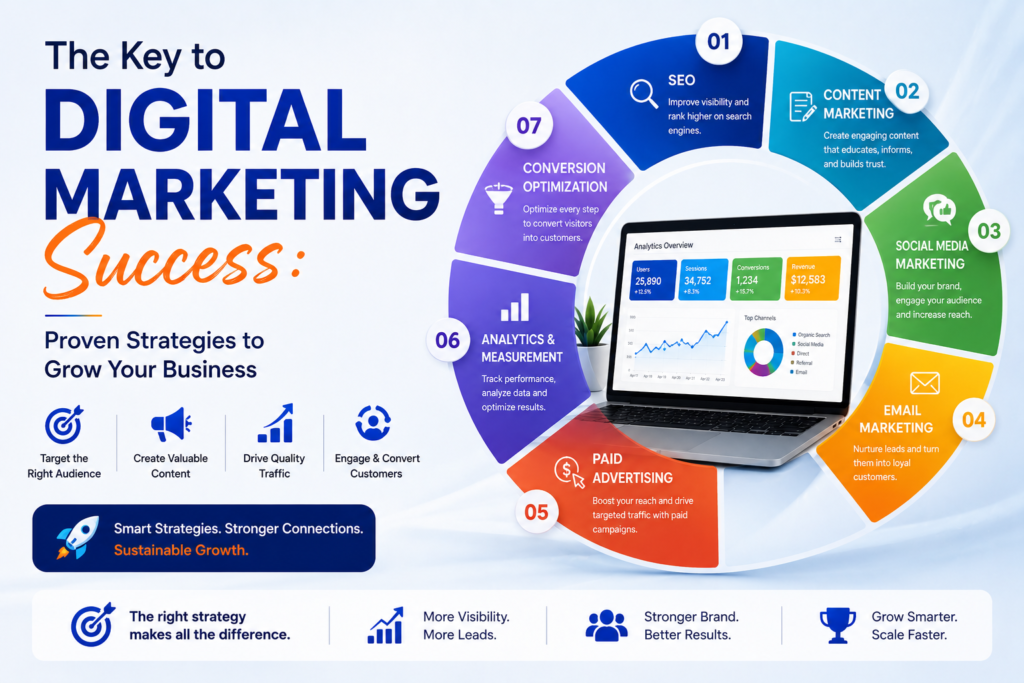
Digital marketing has evolved into one of the most powerful tools for business growth. With customers spending more time online than ever before, businesses need more than just a website or social media presence to stand out. They need a well-planned digital marketing strategy that attracts the right audience, builds trust, and drives measurable results.
Successful digital marketing is not about following every new trend—it’s about understanding your customers, delivering valuable content, optimizing every stage of the customer journey, and using data to make smarter decisions.
In this guide, we’ll explore the essential pillars of digital marketing success and explain how businesses can build sustainable online growth through customer-focused strategies, SEO, content marketing, community engagement, and conversion optimization.
What Makes Digital Marketing Successful?
A successful digital marketing strategy is built on understanding customer needs and aligning every marketing activity with business goals.
Rather than focusing only on generating website traffic, successful businesses prioritize:
- Delivering value to customers
- Building trust and credibility
- Creating personalized experiences
- Optimizing conversions
- Measuring performance continuously
When these elements work together, businesses can improve customer acquisition, increase retention, and achieve long-term growth.
Why Customer-Centric Marketing Matters
Modern consumers expect brands to understand their needs and provide personalized experiences.
A customer-centric marketing approach places the audience at the center of every decision.
Businesses can achieve this by:
- Understanding customer behavior
- Analyzing buying journeys
- Creating personalized campaigns
- Providing excellent customer support
- Maintaining transparent communication
Customer satisfaction doesn’t just improve loyalty—it also increases referrals, positive reviews, and repeat purchases.
Brands that consistently deliver exceptional customer experiences build stronger relationships and long-term trust.
Creating a Winning Content Strategy
Content remains one of the most valuable assets in digital marketing.
High-quality content helps businesses educate customers, answer questions, improve search rankings, and establish industry authority.
An effective content marketing strategy should include:
SEO-Optimized Blog Content
Publishing informative articles helps attract organic traffic while answering customer queries.
Educational Videos
Videos simplify complex topics, improve engagement, and increase audience retention.
Visual Content
Infographics, carousels, and interactive graphics make information easier to understand and share.
Case Studies and Success Stories
Real-world examples build credibility and demonstrate proven results.
Email Marketing
Regular newsletters keep customers informed while nurturing long-term relationships.
Creating content for every stage of the customer journey helps businesses generate consistent traffic and qualified leads.
The Importance of SEO in Digital Marketing
Search Engine Optimization (SEO) is the foundation of sustainable digital growth.
SEO helps businesses improve visibility on search engines by optimizing website content, structure, and user experience.
An effective SEO strategy includes:
Keyword Research
Identify the search terms your audience uses to find products or services.
High-Quality Content
Create content that answers user questions and provides genuine value.
On-Page Optimization
Optimize page titles, headings, meta descriptions, internal links, and images.
Technical SEO
Improve website speed, mobile responsiveness, crawlability, and Core Web Vitals.
Link Building
Earn high-quality backlinks from trusted websites to strengthen domain authority.
A strong SEO strategy increases organic traffic while reducing dependence on paid advertising.
Contextual and Personalized Marketing
Generic marketing messages no longer deliver the same results.
Today’s consumers expect personalized experiences based on their interests, behavior, and stage in the buying journey.
Businesses can improve relevance by:
- Segmenting audiences
- Personalizing email campaigns
- Recommending relevant products
- Delivering location-based offers
- Using behavioral targeting
Providing the right message at the right time significantly improves engagement and conversion rates.
Building an Engaged Online Community
Digital marketing extends beyond attracting customers—it also involves building meaningful relationships.
Strong online communities help businesses:
- Increase customer loyalty
- Encourage user-generated content
- Collect valuable feedback
- Improve brand advocacy
- Strengthen customer retention
Brands can foster engagement through:
- Social media discussions
- Live webinars
- Q&A sessions
- Online groups
- Interactive content
- Customer appreciation campaigns
An engaged community creates long-term value beyond individual sales.
Conversion Rate Optimization Strategies
Driving traffic is only one part of digital marketing success.
The real objective is converting visitors into customers.
Effective conversion rate optimization (CRO) strategies include:
A/B Testing
Test different headlines, layouts, calls-to-action, and landing pages to determine what performs best.
Clear Call-to-Action (CTA)
Guide users toward the next step with compelling and visible CTAs.
Landing Page Optimization
Design focused landing pages that minimize distractions and highlight customer benefits.
Faster Website Performance
A fast-loading website improves user experience and reduces bounce rates.
Mobile-Friendly Design
Ensure every page works seamlessly across smartphones, tablets, and desktops.
Continuous testing and optimization help businesses maximize the return on their marketing investment.
Measuring Digital Marketing Performance
Successful marketing decisions rely on accurate data.
Key performance indicators (KPIs) include:
- Website traffic
- Organic search rankings
- Conversion rate
- Cost per lead (CPL)
- Customer acquisition cost (CAC)
- Return on Investment (ROI)
- Customer lifetime value (CLV)
- Email open and click-through rates
Regular performance analysis helps identify opportunities for improvement and ensures marketing budgets are invested effectively.
Our Approach: Helping Businesses Achieve Digital Marketing Success
At 8 Views, we believe every digital marketing campaign should deliver measurable business outcomes.
Our approach combines SEO, content marketing, paid advertising, social media, analytics, and conversion optimization into a unified strategy that supports long-term growth.
We begin by understanding your business goals, audience behavior, and competitive landscape. Using data-driven insights, we develop customized marketing strategies that increase visibility, generate qualified leads, improve customer engagement, and maximize return on investment.
By continuously monitoring campaign performance and refining our approach, we help businesses stay ahead in an ever-changing digital environment.
Conclusion
Digital marketing success is not achieved through isolated tactics—it comes from building a comprehensive strategy centered on customer needs, valuable content, search engine optimization, personalized experiences, and continuous performance improvement.
Businesses that combine creativity with data-driven decision-making are better equipped to attract the right audience, strengthen customer relationships, and achieve sustainable growth.
As digital marketing continues to evolve, organizations that invest in strategic planning, optimization, and meaningful customer engagement will maintain a strong competitive advantage in the marketplace.
Frequently Asked Questions (FAQs)
1. What is the key to digital marketing success?
The key to digital marketing success is combining customer-focused strategies, high-quality content, SEO, personalized marketing, and continuous performance analysis to achieve measurable business results.
2. Why is customer-centric marketing important?
Customer-centric marketing helps businesses understand audience needs, improve user experience, build trust, and increase customer loyalty, resulting in higher conversions and long-term growth.
3. How does SEO contribute to digital marketing success?
SEO improves website visibility on search engines, attracts qualified organic traffic, enhances user experience, and increases opportunities for lead generation and sales.
4. What is conversion rate optimization (CRO)?
Conversion Rate Optimization (CRO) is the process of improving websites and landing pages to increase the percentage of visitors who complete desired actions, such as making a purchase or submitting a contact form.
5. How can businesses measure digital marketing performance?
Businesses can track KPIs such as website traffic, keyword rankings, conversion rates, cost per lead, ROI, customer acquisition cost, and customer lifetime value to evaluate campaign effectiveness and optimize future marketing efforts.